
In construction, quality problems are found in three places: at the crew's own check, at an inspection, or on the punch list at handover. Each step later costs more, because finished work has to be opened up and redone, and it often affects the next trade.
This guide covers inspection and test plans with hold points, mock-ups, first-time quality, and how to manage a punch list. The worked example turns a 240-item list into a burn-down and estimates what earlier inspection would save.
Before You Start
Why Construction Quality Needs a System
Rework Is Costly
Fixing work that was done wrong consumes labor, materials, and schedule, and it often disrupts the trade that follows.
Defects Found Late Cost More
A gap in a wall found before the finish goes on is cheap to fix. Found at handover, it means removing and redoing finished work.
Every Project Is a Prototype
Unlike a factory, each building is different, so quality depends on planning, mock-ups, and inspection, not on repetition alone.
The Owner Judges the Result
The punch list and the first months of occupancy shape the owner's opinion of the whole project.

Inspection and Test Plans
An inspection and test plan (ITP) lists, for each critical activity, what will be checked, against which requirement, how often, by whom, and at what point. Points are usually of three kinds:
| Point type | Meaning | Example |
|---|---|---|
| Hold point | Work stops until an authorized person has inspected and released it | Reinforcement inspected before concrete is placed |
| Witness point | The inspector is invited to watch, but work may proceed if they do not attend, per the plan | Pressure test of a pipe run |
| Review point | Records or results are reviewed | Concrete test results, welding records |
Good ITPs concentrate on where a failure would be costly or hard to see later: work that will be covered, structural and life-safety items, and things that were wrong on previous projects. Add first-article mock-ups for repeated work, such as a sample wall or bathroom, so that the standard is agreed before the crews build fifty of them.
Build It Right the First Time
- Clear the constraints first. Work started with missing information or materials is more likely to be wrong. The Last Planner System screens for them.
- Define done. Give each task a written completion standard so the next trade knows what to expect. This is the idea behind the first-time-through measure.
- Inspect early and often. Check the first unit of each repeated task, then sample. Self-inspection by the crew catches errors while the person is still there.
- Mistake-proof where you can. Templates, jigs, color coding, and checklists prevent errors. See the Mistake-Proofing Guide.
- Find root causes. Use the 5 Whys when the same defect shows up on several floors.
Worked Example: Managing a Punch List
At substantial completion, a building has a punch list of 240 items. The numbers are illustrative.
| Category | Items | Share |
|---|---|---|
| Finishes (paint, drywall, flooring) | 96 | 40% |
| Mechanical, electrical, and plumbing | 58 | 24% |
| Doors and hardware | 40 | 17% |
| Cleaning | 26 | 11% |
| Other | 20 | 8% |
| Total | 240 | 100% |
The team assigns each item to a trade with a due date, tracks it in a shared list, and reviews the trend weekly. They also ask why the list is so long. Finishes are 40% of the items, and most come from work covered up or touched later by another trade. On the next building the team adds a finish inspection, with a mock-up, before each trade leaves a floor.
Put a value on it. Suppose a finish defect costs $180 to fix at the punch stage and $60 if caught at the trade's own inspection, since crews are still on the floor. If the new inspection catches 40% of the punch items, 96 of 240, the fix cost falls from 240 × $180 = $43,200 to 96 × $60 + 144 × $180 = $31,680. The saving is $11,520 on this building, before counting any schedule benefit at closeout. The unit costs are assumptions to replace with your own.
Log and track your own list with the Punch List and Inspection Tracker Template.
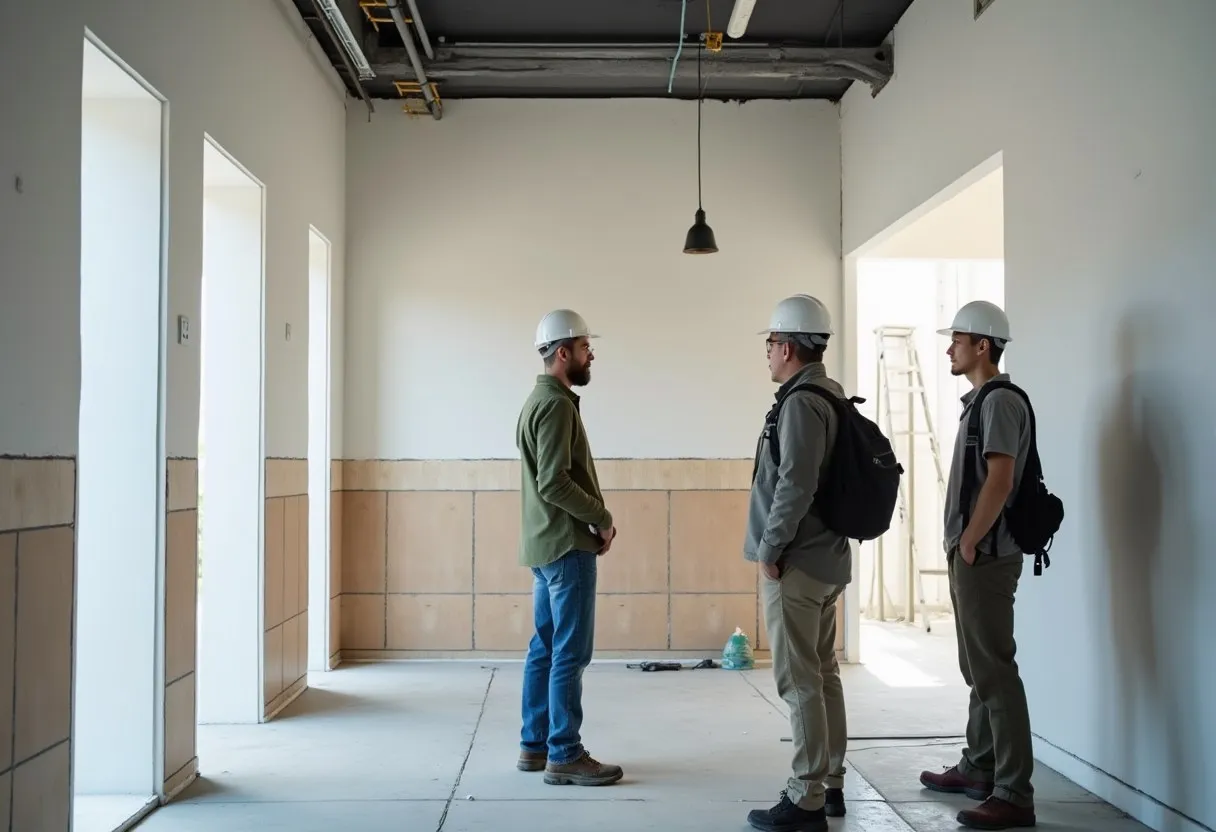
Quality Along the Work: Checks at Each Stage
Quality in construction is built in along the workflow, not inspected in at the end. Each stage has its own checks, and a problem caught early costs a fraction of one found at handover.
Hold points before work is covered. Some work cannot be reached after other work is installed, such as in-wall piping, reinforcing steel, and waterproofing. Define hold points where an inspection must be completed before the next step begins.
Inspect the first in place. In repeated work, the first unit of each type is checked with the trade, the supervisor, and the inspector. Agree what is acceptable before hundreds of units are installed.
Use a short, specific checklist for each inspection, based on the specification and on past defects. Record the result, and photograph the condition where needed.
Give feedback quickly. A defect should go back to the responsible trade, with a photo and location, in the same day. A list that reaches the trade weeks later is hard to fix and hard to learn from.
Shortening the Punch List and Handing Over Well
A long punch list at the end means that quality was left to the end. Reducing it means finding causes and fixing them earlier.
- Analyze by cause and by trade. A Pareto chart of punch items by type and by trade shows where to focus, such as painting touch-ups or missing hardware.
- Inspect by area as it is finished, not as one big walk at the end, and close items continuously so that the list never becomes large.
- Assign each item an owner and a due date, and track its age. Items with no owner do not get closed.
- Verify closure. A trade saying that an item is fixed is not the same as an inspector confirming it.
- Prepare the handover package in parallel: as-built drawings, operating manuals, warranties, test and commissioning records, and training for the owner's staff.
| Measure | What it tells you |
|---|---|
| Punch items per unit or per area | Overall quality of the work |
| First-time inspection pass rate | Quality at the point of work |
| Age of open items | Responsiveness of trades |
| Rework cost and time | Cost of poor quality |
| Warranty claims after handover | Whether defects escaped |
Learn from warranty and owner feedback. Defects reported after handover show what the inspections missed, and they should change the checklists. See the Last Planner Guide, the Pareto Analysis Guide, and the Mistake-Proofing Guide. Figures in the examples are illustrative.
Self-Assessment Questions
- Do critical activities have an inspection and test plan with hold points?
- Do we build mock-ups for repeated work and agree the standard before production?
- Do crews inspect their own work before it is covered or handed over?
- Is the punch list owned, dated, and reviewed weekly?
- Do we analyze the causes of punch items and feed them into the next project?
Common Mistakes
Inspecting Only at the End
Late inspection finds defects when they are most expensive to fix. Check early and at trade handoffs.
A Punch List With No Owner
Items without a named person and date sit forever. Assign every item.
Skipping Mock-Ups
Repeating an unapproved standard across a whole floor multiplies the same defect.
Fixing Symptoms
Closing the same defect again on the next floor means the cause was never found. Use root cause analysis.
Construction Quality and Punch Lists: Frequently Asked Questions
What is a punch list?
A punch list is a list of items of incomplete or defective work found near the end of a construction project, which the contractor must fix before final acceptance. It is usually compiled by walking the building and recorded with location, description, responsible trade, and due date, then tracked until every item is closed.
What is a hold point in an inspection and test plan?
A hold point is a stage at which work must stop until an authorized person has inspected it and released it, such as inspecting reinforcement before concrete is placed. Hold points are used where later work will cover the item or where a failure would be costly or dangerous.
How can we reduce punch list items?
Catch defects earlier with crew self-inspection, inspection at trade handoffs, and mock-ups that fix the standard before production. Clear constraints before work starts, give each task a written completion standard, and analyze the causes of recurring items so they are fixed at the source on the next project.
Sources and Further Reading
- Construction Industry Institute, research on rework and quality management in construction.
- Peter E. D. Love and colleagues, research on the cost and causes of rework in construction projects.
- Lauri Koskela, Application of the New Production Philosophy to Construction.
- ASQ, The Quality Toolbox and resources on inspection planning.